
Spiritual Awakening Signs According to Ancient Indian Texts
I want to begin with an honest statement: spiritual awakening is one of the most misrepresented subjects in modern wellness culture.
The version sold in bestselling books and Instagram reels — sudden bliss, permanent peace, a life transformed overnight — has very little to do with what the actual ancient texts describe, and even less to do with what I have witnessed in the decades I have spent working with serious practitioners.
Real awakening, as described in the Vigyan Bhairav Tantra, the Yoga Sutras, and the Mandukya Upanishad, is more subtle, more gradual, and in many ways more demanding than the popular version. It is also more genuine, more lasting, and ultimately more satisfying. Let me tell you what it actually looks like.
In the modern wellness world, "spiritual awakening" has become one of the most searched and discussed topics online. Yet much of what is written about it is vague, romanticized, or disconnected from the precise, detailed descriptions found in actual ancient texts.
The ancient Indian tradition — particularly through texts like the Vigyan Bhairav Tantra, the Yoga Sutras of Patanjali, the Mandukya Upanishad, and the Tripura Rahasya — describes spiritual awakening not as a mystical accident but as a verifiable, recognizable shift in the quality of consciousness. These texts list specific signs, describe the process in detail, and crucially, provide guidance on how to move through it.
🕉 Important Context: In the ancient tradition, "awakening" is not a permanent instant event but a process — often unfolding over months and years. The signs described below may appear gradually, intermittently, or in various combinations. They are not causes for alarm, but indicators that something important is happening in your inner life.
What Do Ancient Texts Say About Awakening?
The Sanskrit word most closely associated with spiritual awakening is bodha — awakening to the true nature of the Self. The Vigyan Bhairav Tantra describes the ultimate state as Bhairava — pure, unbounded awareness that is not separate from the world but is the very ground in which it appears.
▶️ Watch & Practice
Learn This Practice on YouTube — Free
Yogacharya has 96 free guided practice videos. Watch the technique demonstrated — then come back and read the full guide.
The Yoga Sutras describe progressive stages of prajna (wisdom-insight) that arise as the mind becomes stilled through practice. The Mandukya Upanishad maps the journey through four states of consciousness: waking, dreaming, deep sleep, and the underlying "fourth" (turiya) — the witness-awareness that contains all three.
All of these traditions agree on one fundamental point: awakening is not the creation of something new but the recognition of something that was always already the case.
Amazon Associate: I earn from qualifying purchases at no extra cost to you.
7 Signs of Spiritual Awakening — According to Ancient Texts
Sign 1: Heightened Sensory Awareness
The Vigyan Bhairav Tantra and Yoga Sutras both describe a sharpening of sensory perception in early stages of awakening. Colors become more vivid. Sounds become richer. Simple experiences — eating, walking, feeling the wind — are noticed with fresh intensity. This is sometimes called sahaja samadhi — effortless, natural awareness — in its early expressions.
Traditional description: The Tantra refers to this as the beginning of pratyahara dissolving — the artificial separation between the senses and the world starts to thin.
Sign 2: Periods of Unexplained Peace or Joy
One of the most consistently reported signs across traditions is the spontaneous arising of peace or joy that has no apparent external cause. You may be sitting quietly, working, or even in a moment of difficulty, and a deep, quiet contentment arises — seemingly from nowhere.
The Yoga Sutras call this ananda — a bliss that is not dependent on circumstances. The Vigyan Bhairav Tantra points to the recognition that this joy is the natural state of pure awareness.
Sign 3: Shift in the Relationship to Thoughts
A significant sign described across ancient texts is when the practitioner begins to notice that thoughts arise and pass — but there is a quality of awareness that notices the thoughts, yet is itself not a thought. This "witness" quality begins to be recognized not just in meditation but in daily life.
Key sign: You begin to notice gaps between thoughts, or notice that you can observe thoughts without being completely identified with them. The Mandukya Upanishad calls this the beginning of recognition of turiya — the fourth state.
Sign 4: Decreased Need for External Validation
The Bhagavad Gita describes the awakened person as one who is "sama" — equanimous — in pleasure and pain, praise and blame. Ancient texts consistently describe this shift: as awakening deepens, the compulsive need for external approval, validation, or circumstances to be a certain way, gradually loosens.
This is not indifference or apathy — it is a groundedness that comes from accessing a source of well-being that is internal rather than external.
Sign 5: Increased Synchronicities
While not all traditions discuss this directly, the Tantric tradition — and the Vigyan Bhairav Tantra in particular — describes the awakening process as one in which the boundary between "inner" and "outer" becomes more porous. Experiences that modern people call "coincidences" or "synchronicities" begin to increase in frequency and significance.
The traditional interpretation: as awareness expands, the perceiver begins to notice connections that were always present but previously invisible to the contracted, habitual mind.
Sign 6: Sensitivity to Energy — in People, Places, and Situations
The Yoga Sutras describe siddhi (enhanced perceptual abilities) arising naturally from sustained practice. Among these is an increased sensitivity to the subtle energies of environments, situations, and people. Many practitioners at this stage find themselves more affected by crowds, by certain places, or by the emotional states of those around them.
This is not a pathology but a natural consequence of expanding awareness. Ancient traditions include specific practices — including pranayama — for grounding and stabilizing this increased sensitivity.
Sign 7: A Turning Toward Simplicity
Perhaps the most consistent sign across all ancient Indian texts is what the tradition calls vairagya — dispassion or detachment from the unnecessary. This manifests as a natural turning toward simplicity: less craving for sensory stimulation, less compulsion toward accumulating possessions or status, and a genuine deepening of appreciation for simple, direct experience.
This is not forced renunciation — it arises naturally as the practitioner increasingly accesses the inner source of contentment that the ancient texts describe as our birthright.
Amazon Associate: I earn from qualifying purchases at no extra cost to you.
Moving Through Spiritual Awakening with Pranayama
Ancient teachers consistently emphasize that pranayama practices — particularly Nadi Shodhana and Kapalbhati — serve as grounding and stabilizing forces during the awakening process. When awareness is expanding rapidly or experiences are intense, breath-based practices re-anchor consciousness in the body and the present moment.
Specifically:
- Nadi Shodhana (alternate nostril breathing) is recommended for balancing and stabilizing
- Kapalbhati for grounding and clearing excess energetic activation
- Anapana for returning to simple, present-moment awareness
Ground Your Awakening — Start with Breathwork
The free 7-Day Breathwork Challenge gives you the grounding practices that ancient traditions used to move through and stabilize awakening experiences. Start for free.
✨ Get the Free 7-Day ChallengeA Final Word
Spiritual awakening, as described in ancient Indian texts, is not a dramatic lightning bolt — though sometimes it can feel that way. More often it is a gradual, deepening recognition: the recognition that what you have been seeking was never absent. The peace, the clarity, the joy — these are not destinations to reach. They are the nature of the awareness reading these words right now.
The ancient practices of pranayama and meditation are not paths to that recognition. They are the dissolving of the obstacles to recognizing what is already, always, fully present.
Recommended Books for the Spiritual Seeker
These classical and modern texts illuminate the journey of awakening through India's wisdom traditions:
- 📚 Vigyan Bhairav Tantra (Osho Commentary, Vol. 1) — The most accessible modern commentary on Shiva's 112 techniques. Essential for understanding the signs of awakening from within this tradition.
- 📚 Vijñāna Bhairava Tantra — Jaideva Singh (Sanskrit Commentary) — The scholarly Sanskrit translation of the original text. For the serious practitioner.
- 📚 Light on the Yoga Sutras of Patanjali — B.K.S. Iyengar — Patanjali's complete map of the inner journey, from dharana through dhyan to samadhi. The classical framework for understanding all awakening signs.
- 🧘 Meditation Cushion (Zafu) — Proper support for long, deep meditation sessions — essential as practice deepens.
- 🎵 Tibetan Singing Bowl Set — Used in many Vigyan Bhairav Tantra practices and for creating sacred space during deep practice.
Disclosure: The above links are Amazon affiliate links. As an Amazon Associate I earn from qualifying purchases at no extra cost to you.
Tags: spiritual awakening signs • kundalini • vedanta • vigyan bhairav tantra
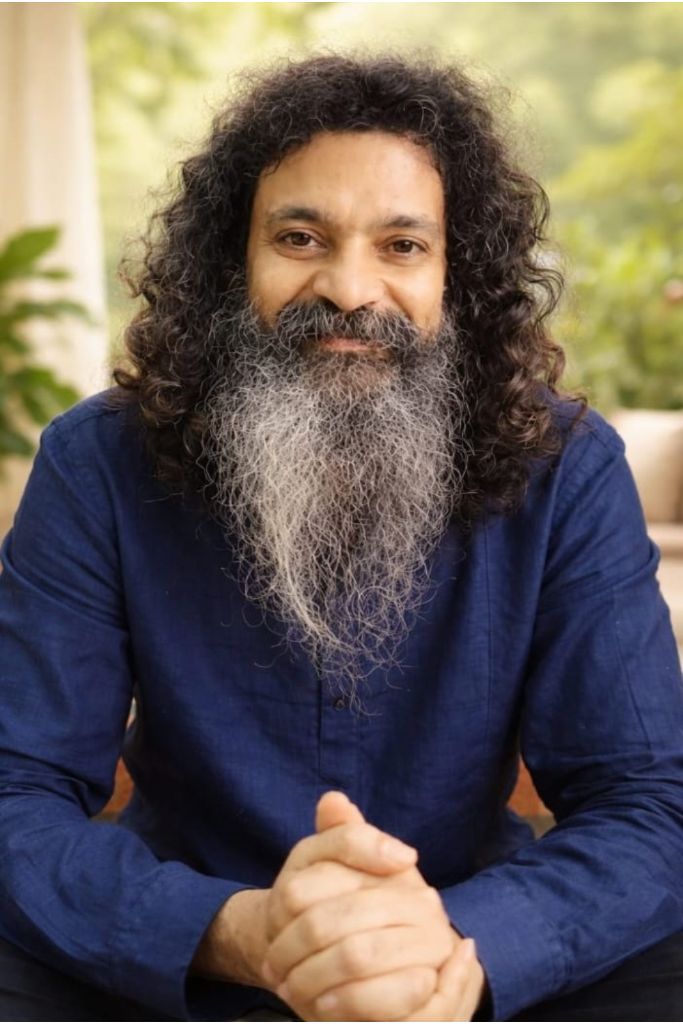
✍️ About the Author
Yogacharya R. Goswami
Master Teacher of Pranayama & Vigyan Bhairav Tantra · 25+ years of lived practice · 1.8M+ seekers worldwide
Start Your 7-Day Pranayama Journey — Free
Ancient Vedic techniques for anxiety, sleep & calm. Delivered to your inbox one day at a time. No experience needed.
🎁 Get My Free 7-Day Guide →🔒 Free forever. 2.5M+ seekers worldwide.